Category Archives: movies

A Review

I have a plethora of foreign, independent, and obscure films available to me here. When I want to learn about something other than Arab culture, my collection of DVD’s provides worthwhile entertainment. Most recently I watched Kundun. This film by Martin Scorsese tells the story of the 14th (current) Dalai Lama’s life from his birth until he was exiled from Tibet to India. With Tibet and China being in the spot light right now, I decided to find out more about the figure of the Dalai Lama.

As the movie explains, the Dalai Lama was believed to be reincarnated into each of its predecessors. The 14th Dalai Lama was found as a child and discovered by Tibetan monks to be the reincarnated leader of Tibet. The boy became a monk and was trained until we was meant to take leadership at the age of 18. Around that time China decided to take over Tibet.

There is a variety of interesting things about this movie. One is its relevance. The tension between China and Tibet right now trace back to the time frame of this movie. From what I could gather, China wanted control of Tibet’s territory because it would benefit them economically, as has proven true. China, however, was and is secular, while Tibetans are deeply religious Buddhists. The Chinese didn’t want the Dalai Lama to hinder their progress, so they drove him out.
Secondly, the film is extremely artistic in the way it portrays the Tibetan culture. Scorsese showcases the people, colors, costumes, traditions, music, chants, and landscape of the people beautifully. He obviously appreciates the novelty of the entire culture.
I was particularly fascinated by the spiritual aspect of the entire film. The fact that an entire nation would stand behind a little boy that is a supposed replica of a previous man is pretty extraordinary. Of course I found this somewhat saddening. The fact that the monks in particular dedicated their entire lives to a child they thought to be someone else is a little disillusioning; nevertheless, it is pretty intriguing.
Overall, this is a good film. It is informative and aesthetically pleasing, but just a little long.

Situation in Darfur Still Volatile


I received this update today from the UNHCR. Despite the continual efforts by various parties to stabilize Sudan through peace treaties, it is evident that the violence in the region of Darfur still rages. There is a lot of evidence that the Sudanese government is linked to the Janjaweed, the rebel force responsible, yet the government does not even acknowledge the countless lives that have been lost since 2003. The genocide in Darfur is unique because it is the first mass killing to be called a genocide before it is over. This gives hope that the world is finally ready to prevent another Holocaust or another Rwanda. Regardless of efforts like the Darfur Now documentary, which effectively shows the legislative progress being made toward justice for all in Darfur, the murders still continue and show no sign of ceasing anytime soon.


Men on horses burn villages

Dear Refugee Supporter,

The UN Refugee Agency is providing humanitarian assistance to over 12,000 refugees from Darfur who recently fled their homes following a series of ground and air attacks on their villages.

Refugees report that their villages were attacked by men on horses and camels – most likely the Janjaweed militia. Villages were looted and burned, and encircled by militia to prevent people from fleeing. Thousands of families have been left destitute and terrified.

“The humanitarian situation of these people is disastrous,” said Jorge Holly, head of UNHCR’s field office in Guereda. “These people are terrified. Our team found a large number of unaccompanied minors and separated children among them. Women reported having been raped in Darfur.”

The newly arrived refugees say that many more—mostly women and children—are on their way to Chad. UNHCR is working to move these new refugees away from the volatile border region and into camps. Once settled in the camps UNHCR will provide relief items, including sleeping mats, blankets, jerry cans and kitchen sets.

This new influx of refugees from Darfur comes amid growing insecurity throughout the region. Last week the capital of Chad was attacked by rebel forces. Nearly 30,000 Chadians fled into Cameroon to escape the violence.

Sincerely,

J. Michael Coburn
Acting Executive Director
USA for UNHCR

Gone Baby Gone


This post has nothing to do with Jordan or what I’m doing here, but I just watched this movie, and it moved me (I’ve gotten a lot of movies here, so this might not be the last post like this). If you haven’t seen Gone Baby Gone, the premise is a private investigator (Casey Affleck) from Boston hired onto a child abduction case. As the plot develops, it becomes clear what it is really about: Right and wrong. Patrick, Casey Affleck’s character, sees things as black and white, but his beliefs are challenged by others who have “seen more of life.” Isn’t it ironic how as people get older they get jaded and lose all of their integrity and morals, rather than growing wiser? Somewhere along the way it’s justifiable to say that two wrongs make a right. In a way, it comes back to my last entry on racism and violence. Everyone thinks that, because of the wrong inflicted on them, they have the right to do the same to someone else. What poor logic this is. People will go to great lengths to make things “right” no matter what the cost. That’s what this movie is about: seeing all the gray areas in life, yet still remembering that sin is sin. Period.
There are many other reasons I liked this movie. There was a realness about it that pervaded its entirety. It was honest and it made me think. Anytime it’s hard to decide who the villain is, that’s an authentic scenario. After all, in real life the bad guys aren’t always wearing black and riding black horses.

Social Injustice and all that good stuff

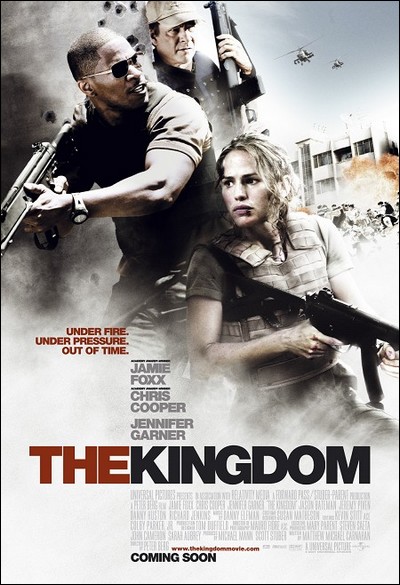
I am compelled to write on this subject because of a few things I have been watching and reading. There are two movies I really like for the same reason. Crash is an old favorite, and The Kingdom is a new one. Both basically send the message that “no one is good, not even one” (Romans 3), concluding that there will be no end to war and violence so long as there is hatred. No amount of revenge will suffice. There will never be a “war to end all wars.” Both movies deal specifically with the social problem that haunts every society: Racism. If you don’t think racism is still an issue where you live, you are fooling yourself. It is everywhere, especially here. I can’t even say “Israel” without getting people upset. Around Arabs you only call that place across the Jordan river “Palestine.”
We are all naturally prejudice against anything and anyone that is different from us. We are innately hateful and prideful. It is just an effect of the fall. Moreover, it is evidence that we cannot and will not be good or do good on our own. Everyone needs the reconciling message of the Gospel, or else chaos ensues.
For whatever reason, I am drawn to victims of racism and prejudice. Maybe this is because they are such stark reminders of the sin in this world and the damage evil can do. A vast majority of the refugees I have worked with are the result of genocide, an obvious example of racism at work. It is easy to be angry at the evil doers and makers of war; however, “the anger of man does not achieve the righteousness of God” (James 1:20). I hope for world peace just as much as anyone else, but more so I pray for the peace that comes to people only through Jesus. An author I was recently introduced to talks about how we, as Christians, are to treat socially oppressed people such as these, as well as their oppressors:

I am going to Iraq because I believe in a God of scandalous grace. If I believed terrorists were beyond redemption, I would need to rip out half of my New Testament Scriptures, for they were written by a converted terrorist. I have pledged Allegiance to a King that loved evildoers so much He died for them [and of course the people of Iraq are no more evil or more holy than the people of the US], teaching us that there is something worth dying for but nothing worth killing for… We are all wretched, and we are all beautiful. No one is beyond redemption. May we see in the hands of the oppressors our own hands, and in the faces of the oppressed our own faces. We are made of the same dust, and we cry the same salty tears. -Shane Claiborne (Quote borrowed off of Jim’s blog)

I think that if we come to this point of understanding, we can in turn find “true and undefiled religion…to visit orphans and widows in their distress” (James 1:27), no matter what their background or differences from ourselves. I encourage you to find the prejudices in your own heart that might be hindering you from “walking in love” (Ephesians 5:2). If this doesn’t convince you, the last scene in The Kingdom definitely will.

“As it is written, ‘There is none righteous, not even one…There is none who does good, there is not even one'” (Romans 3:10,12).